
How to Read Letters from Organisations
Letters from organisations can feel intimidating. Whether it is from the council, a GP, your landlord, school, benefits, or a company you have never heard of, it is normal to feel your stomach drop before you even open the envelope. Many young people, especially those who moved placements or dealt with crisis growing up, link letters with stress or bad news.
You deserve to understand your letters without panic.
This guide gives you gentle, clear steps, supported by real-feeling stories, so you can feel more in control of your post.

Short stories from real experiences
The stories below are based on real situations shared by young people. Names and small details have been changed for safeguarding, and the examples show how common letter-related anxiety is and how understanding the letter can change how it feels.
Story 1: Sam and the overwhelming brown envelope
Sam, 18, was living in semi-independence when a brown envelope arrived with “Important information enclosed” stamped across the front. His heart raced. He left it unopened for two days because he thought it might be about rent arrears.
When he finally opened it with support, it turned out to be a routine update about his council tax exemption. Nothing scary. Nothing urgent.
Why this mattered:
Sam realised that avoiding letters made the anxiety worse. Opening them with support helped him feel safer and less alone.
Story 2: Jade and the confusing benefit letter
Jade, 22, received a letter from the Department for Work and Pensions full of numbers she did not understand. She panicked, thinking her benefits were being stopped. A friend looked at it with her and spotted the line that said “Your payment will stay the same.”
The rest was standard wording.
Why this mattered:
Jade learned that most letters follow a template. Even serious-looking letters often include normal, non-urgent information.
How to Read Letters from Organisations

This checklist helps you break down any letter calmly and clearly. You do not need to do every step each time.
Click the sections below and take it one step at a time.
-
Before reading anything, help your body feel a little safer.
You might:
sit down
take a few slow breaths
have a drink or grounding item nearby
Why this helps:
Feeling physically settled can reduce panic and make the information easier to process. -
Find who the letter is from. This gives you instant context.
Common senders include:
Council
GP or hospital
DWP
Landlord or housing association
Bank
School or training provider
Utilities such as energy or water
Why this helps:
Knowing the sender makes the letter feel less unknown and helps you understand what it is likely to be about. -
Look for the day, month, and year.
Why this helps:
The date tells you how recent the information is and helps you judge whether it might be urgent. -
You do not have to read the whole letter at once.
Many letters explain the main point straight away, for example:
“We are writing to confirm your appointment.”
“We need some information from you.”
“This is your updated bill.”
“Your payment will be…”
Why this helps:
The first line often tells you the purpose and can lower panic immediately. -
Scan the letter for signposted information such as:
Dates
Actions you need to take
Appointment times
Deadlines
Amounts owed
Why this helps:
Organisations use bold text to guide you. You can use this to spot important information quickly. -
If a paragraph feels overwhelming, shrink it.
You can try:
Reading one line at a time
Placing your finger under each sentence
Taking short breaks between sections
Why this helps:
Your brain processes information better in small chunks, especially when anxiety is present. -
Look for phrases like:
“Please contact us by…”
“You need to provide…”
“Send this back to us…”
“We require documents…”
If the letter does not ask for action, it may simply be for information.
Why this helps:
Knowing whether action is needed is one of the quickest ways to reduce stress. -
If something needs doing, take it out of the letter and put it somewhere visible.
You could:
Add a reminder on your phone
Screenshot the letter
Write the task in your notes app
Put it in your “to deal with” spot
Ask someone to remind you if you need support
Why this helps:
This stops you having to hold everything in your head. -
You are allowed to ask for clarification.
You could ask:
a friend
a PA or support worker
your social worker
a trusted adult
the organisation itself
You can say:
“Hi, I have a letter here and I’m struggling to understand it. Could you explain it in a simpler way please?”Why this helps:
It is their job to help you understand. Asking is not going to make them mad and does not mean you are doing anything wrong. -
Once you have read it, give it a home.
You might:
Place it in your important documents folder
Take a clear photo as a backup
Label it if that helps you organise
Why this helps:
Keeping letters in one place reduces future stress if you need to refer back to them.
These are just suggestions. You may have other techniques you practice already.
If you prefer a visual resource, we’ve also included a checklist below:
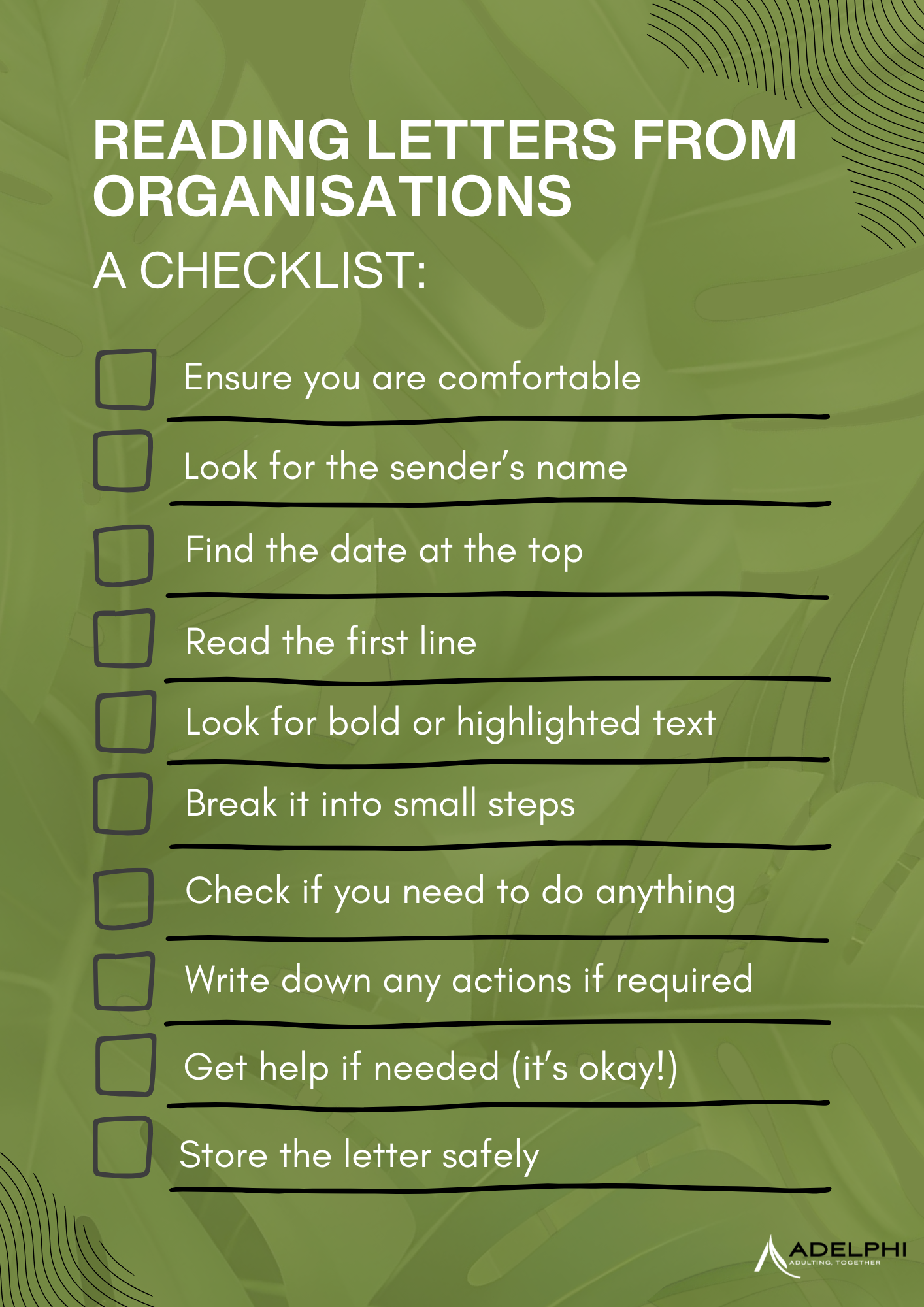
Simply save this image if you need it, or download it as a PDF here
Reflective moment
Letters can feel larger than life. For many young people, they bring up memories of sudden changes, warnings, placement moves, or difficult news. It makes sense if your instinct is to avoid them. You are not weak for feeling this way.
Learning to read letters calmly is not about becoming perfect at adult life. It is about giving yourself more security, understanding, and control. You are building skills that many people learned with long-term support. You are doing this independently, and that matters.
Conclusion

Letters from organisations can feel confusing, but with a simple checklist, a quiet moment, and support when you need it, you can understand them clearly and confidently.
You are doing better than you think.
Whenever in doubt, come back to this guide and take it step by step.