
Creating a Savings Plan
Saving money can feel impossible when you are young, on a tight budget, or juggling benefits and work at the same time. Many people quietly feel ashamed for not having savings, but the reality is that most young adults do not have much saved at all.
Living costs are high. Income can be unpredictable. Social media makes it look like everyone else has it figured out.
A savings plan is not about being perfect or hitting big numbers.
It is about building a little stability in a way that feels safe, realistic and manageable for you.
This guide is here to help you start gently, at your own pace.
If you’d like a quick visual guide to simple money-saving ideas before reading on, watch this short video first.
How to use this step by step guide
You can read this all at once, or dip in and out.
If you are using the accordion version below, tap each heading to open only what feels useful right now. There is no right order.
-
A savings plan should fit your actual life, not an ideal one.
Your income might come from work, Universal Credit, PIP, student loans, part-time jobs, occasional shifts or local support.
You do not need big numbers to start saving. You just need honesty about what you can manage. -
Saving works best when it does not overwhelm you.
That might be £1, £2, £5, spare change or round-ups in your banking app.
Tiny amounts matter more than people think. Consistency is more important than size. -
When savings sit with spending money, they disappear easily.
You could use:
a savings pot in your banking app
a separate savings account
a physical jar if that feels easier
Keep it visible, but not mixed into everyday spending.
-
Saving feels easier when there is a purpose.
Your goal might be an emergency buffer, moving costs, clothes, education, travel, Christmas or even mental health rest days.
Your goal does not need to impress anyone. It just needs to matter to you. -
Some people save weekly. Others save on payday, through round-ups, or whenever there is extra.
If your income changes often, weekly saving usually feels more manageable than monthly.
-
Automation removes stress.
You might:
set up a standing order
use bank automation tools
round up card payments
This helps savings happen without constant decision-making.
-
Some weeks will be tighter than others.
It is okay to reduce your savings, pause it, or restart later.
A savings plan should reduce stress, not add to it. -
Life happens. Bills change. Things break. Mental health dips.
If you use your savings, that is not failure.
That is the plan working as intended. -
Comparison culture makes saving harder.
Social media often hides family support or financial help behind the scenes.
Your savings plan should match your life, not someone else’s highlight reel. -
Saving is not a one-time decision.
Check in with yourself:
Is this amount still manageable?
Can I increase or reduce it?
Has my goal changed?
A good plan grows with you.
a visual checklist:
If you prefer a visual checklist to work from, you can save the image below.
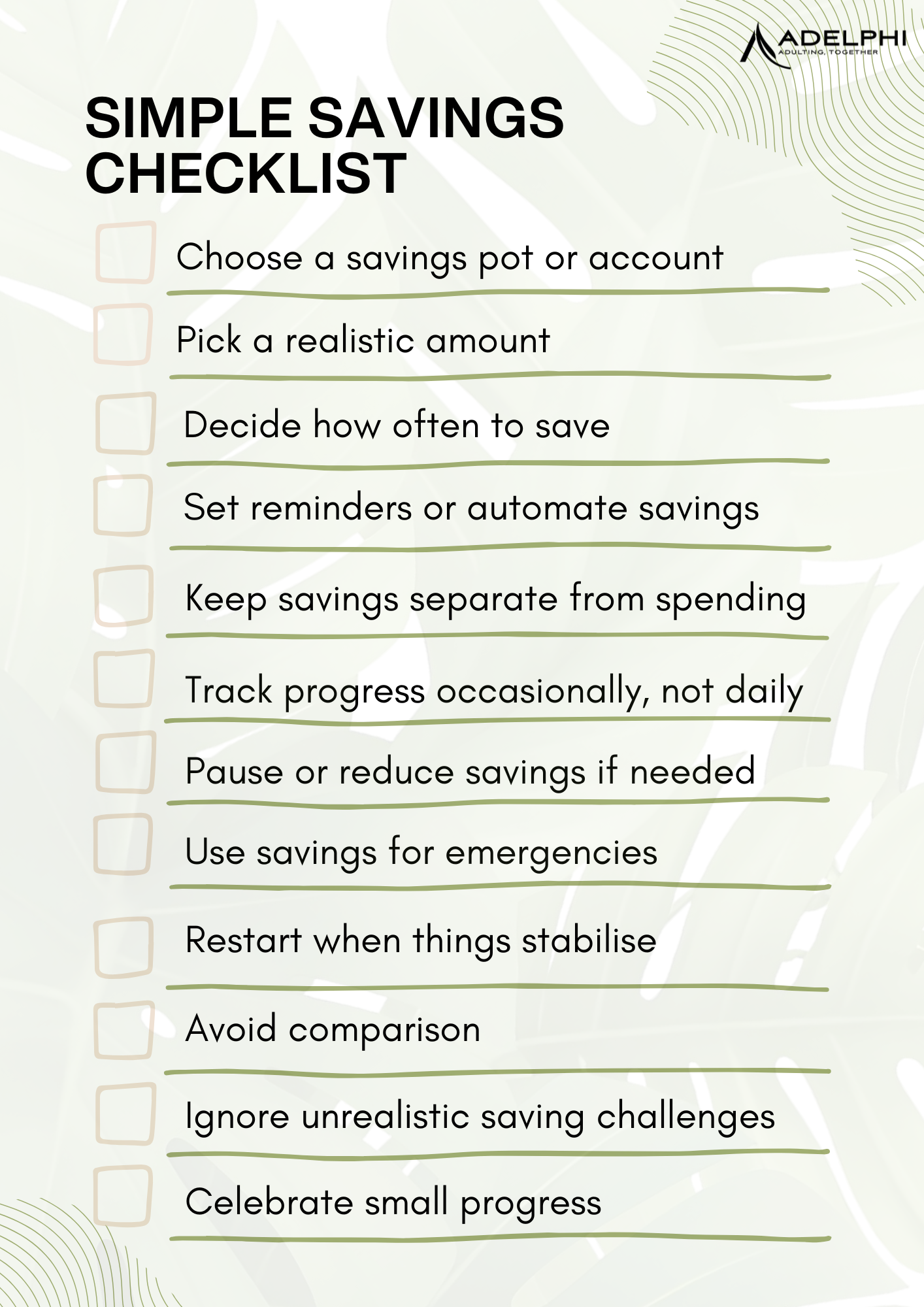
Save the image above, or download as a PDF here
A realistic reminder
It is normal if:
saving feels slow
you dip into your savings
bills take up most of your income
money feels unpredictable
None of this means you are bad with money.
It means you are learning and building independence in a tough financial climate.
In summary

Saving does not need to be perfect, complicated or impressive.
It is simply a steady habit that builds stability over time.
Start small.
Stay flexible.
Adjust when you need to.
And celebrate every step forward, even if it is one pound at a time.