
Your Rights as a Tenant (and Care Leaver)
Moving into your own home is one of the biggest steps toward independence. It can feel exciting and scary at the same time. If you have grown up in care, you might not have had the chance to learn about renting in the same way other people do. So if housing, paperwork or landlord conversations feel confusing, that does not mean you are doing anything wrong. It simply means no one taught you.
This article is here to change that.
You deserve to know your rights, feel safe and understand what support exists for you.

A gentle reminder before we begin

Many care leavers worry about:
being blamed for problems
asking questions and sounding inexperienced
losing their home if they make a mistake
reporting repairs in case it causes trouble
understanding complicated tenancy words
getting overwhelmed by housing issues
These worries are real and valid.
This guide is written to make things clearer, safer and calmer for you.
You do not need to know everything today. You are learning, and this is where you will build both confidence and power; both now, and moving forward in life.
Your Rights as a Tenant: Simple, Clear and Human
You’ll see the rights below laid out in sections you can tap or click to open. Each one explains a different part of your tenant rights, in plain language.
You do not need to read everything in one go.
You can open one section, save this page, and come back whenever you need to.
This checklist is here to:
help you understand what you are entitled to
give you words if you ever need to speak up
remind you that asking for help is allowed
There is no test at the end.
This is something you can keep and return to, whenever life throws something housing-related at you.
-
Your landlord is legally responsible for making sure your home is safe.
This includes:
working heating and hot water
safe electrics
a stable structure
windows and doors that lock
working smoke alarms
carbon monoxide alarms where required
no serious hazards
Your home must be fit to live in.
This is the law. -
If something breaks and it is not your fault, your landlord must fix it.
This includes:
boilers and radiators
electrics
leaks
toilets and plumbing
broken windows or doors
damp and mould caused by the building
Asking for repairs is not complaining.
It is part of your rights as a tenant. -
A landlord cannot treat you differently because:
you grew up in care
you are young
you receive benefits
you do not have family support
If someone speaks to you disrespectfully, dismisses you or tries to take advantage, you are allowed to challenge it.
You deserve respect.
-
You can always ask for things to be explained again or in simpler words.
A supportive landlord or housing officer should never:
rush you
make you feel silly
pressure you
refuse to explain things
It is your home, and you deserve clarity.
-
Your landlord must give you proper notice before entering your home (usually 24 hours unless it is an emergency).
This includes:
inspections
repairs
contractor visits
Having your own space is your right.
You are allowed to say no to unannounced visits. -
Before you hand over any money, you should receive:
a copy of the tenancy agreement
the deposit protection details
the rent amount and payment schedule
safety certificates (such as gas checks)
the landlord or agent contact information
You are allowed time to read your agreement. You can ask someone to look at it with you.
-
This is the part many young people do not know - and it is important.
You are entitled to extra support with housing under national guidance, including:
a. Your council must publish a Local Offer for Care Leavers
This must include accommodation support. Source: https://www.gov.uk/government/publications/joint-housing-protocols-for-care-leavers
b. You have a right to help finding suitable accommodation
Councils must work together to prevent homelessness for care leavers through joint housing protocols. Source: https://www.gov.uk/government/publications/joint-housing-protocols-for-care-leavers
c. You have a right to housing support until at least age 21
And up to age 25 if you request continued support through your Personal Advisor. Source: https://www.gov.uk/after-you-leave-care
d. Your Pathway Plan must include housing
Accommodation is a required part of your Pathway Plan.You can ask for your plan to be updated if your situation changes.
e. If you are at risk of homelessness, you are a priority group for support
Local authorities must provide homelessness prevention and advice. Source: https://www.gov.uk/homelessness-help-if-youre-under-21-and-were-in-care
f. You can request help to maintain your tenancy
This can include support with communication, repairs, budgeting or managing responsibilities.
These rights exist because the system recognises that you deserve stability and support. You are not expected to manage everything alone.
Your Care Leaver Tenancy Rights Checklist
Below is a simple checklist that brings together your key tenancy rights as a care leaver, based on everything covered in this article. It’s designed to make things clearer and easier to hold onto, especially if housing information has ever felt confusing, rushed or overwhelming.
You do not need to remember all of this.
You can save or screenshot the checklist and come back to it whenever you need to - before signing a tenancy, when something goes wrong, or just for reassurance that you are allowed to ask for support.
This checklist is here to help you feel more confident in your rights, give you language if you ever need it, and remind you that you are not expected to manage housing on your own.
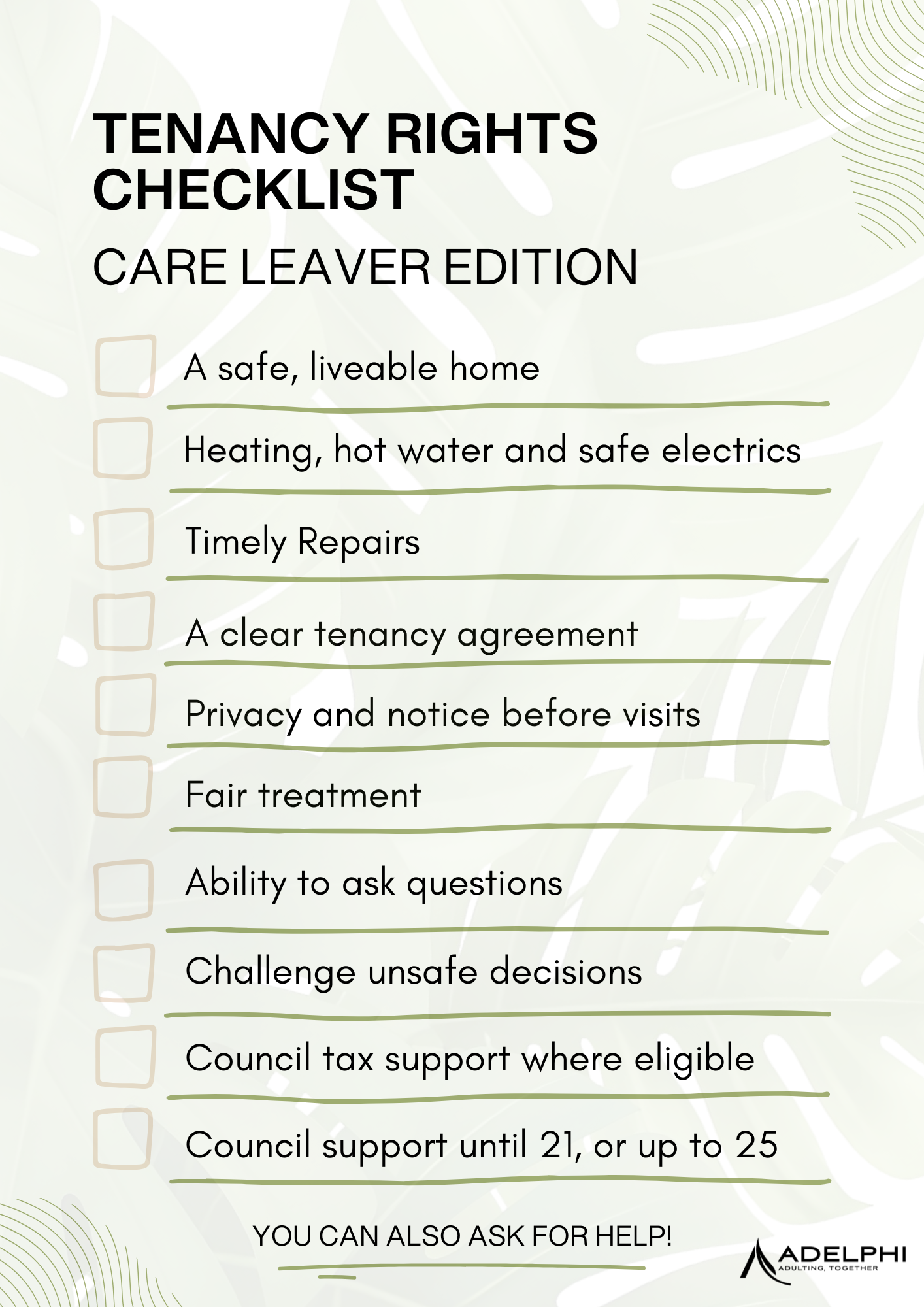
You can either save this image to your device, or download as a PDF here
Your Care Leaver Offer
Every local authority must publish a Care Leaver Offer that explains the support available to you, including help with housing, council tax, finances and ongoing advice. You are allowed to ask for this and to have it explained in a way that makes sense to you.
You can also find clear, national information about Care Leaver Offers at careleaveroffer.co.uk, which brings together what councils should be providing and what you are entitled to ask for.
As we say at Adelphi: you don’t know what you don’t know — and adulting shouldn’t mean doing it alone.
A final, steady reminder

If learning about your rights brings up worry, doubt or even frustration, that is completely understandable.
Many care leavers were never given the chance to learn this information in a calm or supportive way.
Knowing your rights does not make you difficult.
Using them does not make you ungrateful.
Asking questions does not put your home at risk.
Your rights exist because you deserve safety, stability and respect. You do not have to prove that you are worthy of them.
Your home should be a place where you can breathe, rest and feel secure. Understanding your rights is not about conflict or confrontation - it is about feeling safer and less alone.
And if you forget something, that is okay too. You can come back to this. You can ask again. You do not have to do adulthood on your own.
At Adelphi, we are here to sit alongside you, without judgement, as you build a life that feels safe, stable and truly yours.